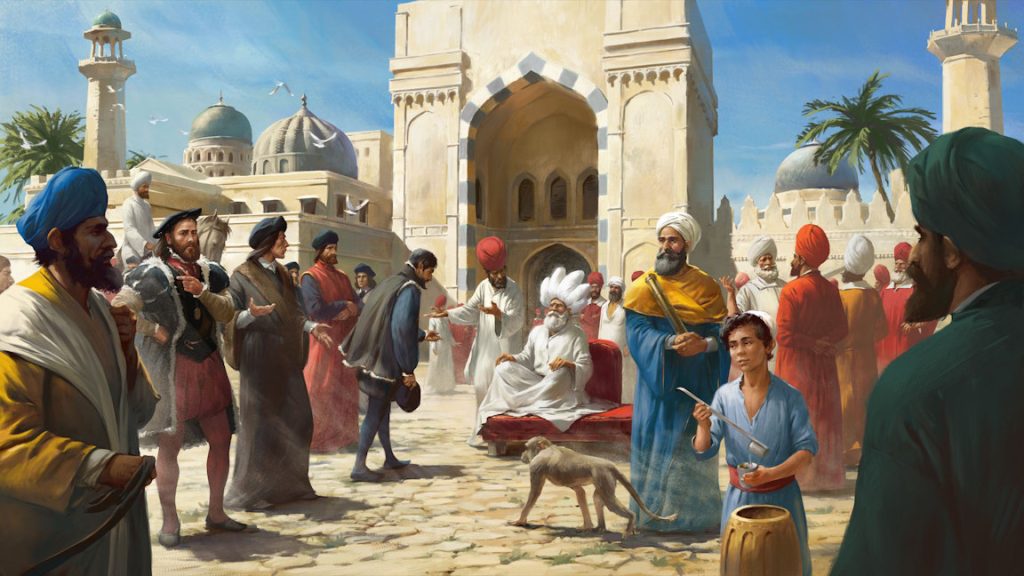
Popping out of hiding just to say that I’m playing Europa Universalis V and I’m so hooked. It’s my first Paradox strategy game and yes, they’ve earned their reputation for being complex. I did the tutorial campaign with Naples and I felt overwhelmed the entire time. It felt like every five minutes I was getting asked to vote on something impenetrable in Latin that the Catholic church was arguing about or I was getting minute-to-minute updates about the random crap my extended royal family was up to (wow, my third cousin just came of age).
I decided to do a new game someplace out of the way so I picked the city-state of Maynila in what’s now the Philippines. That’s when things finally clicked for me. There’s less content for this area of the world so there’s not as many interruptions about the Baltic crusades or whatever. My ruler is the founder of his dynasty so he doesn’t have a million uncles trying to interfere in his life. Since it’s a single location I don’t have to worry about how the Control and Integration game mechanics work, and everyone is 100 percent the same ethnicity and religion and speak the same language so I also don’t have to worry about how to keep a multi-ethnic polity happy. Plus, my immediate neighbours are just as weak as me and the big boys (the Yuan Dynasty, Ashikaga Shogunate, and Majapahit empire) are too far away to give much of a crap about me.
So I spent the first fifteen years just learning how international trade worked as well as getting into the special options for Hinduism. I still don’t entirely get how buildings and development work – frankly, I think the UI is too confusing for this – but I think I’m slowly getting the hang of it. I finally managed to overthrow my sovereign, Brunei, and as part of the peace settlement I annexed a couple of my fellow vassals and greatly expanded my population and territory, so I’m going to have to learn about how ruling multiple provinces works now.
I do wonder if there’s a mechanic for peacefully ending your vassalage. Perhaps you can negotiate something if you become a lot more powerful than your suzerain?
But anyway, this campaign is really fun for me. I may try to unite the Philippines and perhaps add some of the nearby islands – Taiwan, Borneo, Sulawesi – but I’m not sure if I really want to be the sovereign of Indonesia. It looks like it might be quite a slog. I think I’ll try exploring the Pacific and getting to the Americas so I can do the neat counterfactual history from stuff like The Years of Rice and Salt. I’m so looking forward to all this.
Godzilla Minus One is most definitely worth watching. I have no nostalgia or any particular like for the million Godzilla films in existence and I still enjoyed it.
The takeaway is that it’s a really great alternate history period piece about a giant monster attacking Japan in 1954. I especially liked that as a period piece, it shows all the historical stuff that you wouldn’t see in a contemporary movie since it would assume that the audience already knows about it – i.e., people living in shacks built on the ruins of their houses, demobilized soldiers trying to find work, the overwhelming presence of the war suffusing everything in postwar society, etc. Basically we see what it looks like when an empire is destroyed.
The biggest criticism I have is political. The movie shows the aftermath of the war, but it doesn’t show what Japan did to bring the war in the first place. The war is presented like a natural disaster that befell the suffering nation. And the final plan to defeat Godzilla involves the Japanese version of the clean Wehrmacht myth (the idea that certain parts of the military were honourable even if their leaders weren’t). See, the stalwart and upright (demobilized) soldiers along with scientists and business leaders from private industry get together to devise clever strategies to defeat an existential threat, which if you think about it rather sounds like how fascism works in the first place. Really puts kind of a bad taste in my mouth.
I know, I sound just like in my review of 13 Sentinels. I suppose Japan has yet to fully grapple with its wartime legacy, but it’s been so long since that war that it’s almost just historical trivia now. I suppose once the children of the imperialist generation finally die out or get assassinated then we’ll get a more sober understanding of what Japan did in its media. But if you can compartmentalize your reaction to how this Godzilla movie treats Japanese fascism, then you’ll discover a quite well-made film.
Thanks to The Wandering Earth, I just read my first Cixin Liu text: his short story collection To Hold Up The Sky. I had tried reading The Three-Body Problem before but quit in the prologue.
It’s because like many other sci-fi writers, Liu is not good at social realism, and the prologue of Three-Body Problem really just could not grab me with its depiction of the Cultural Revolution. But thankfully I could skip the stories in this collection that showcased too much of the weaknesses of Liu’s writing and go with his real strength – the sci-fi crap. He’s very old school in that way.
For instance, the first story in the book is about a teacher in a dirt-poor mountain village and it was a struggle for me to keep reading until aliens finally showed up. I also completely skimmed the story about coal miners which had nothing science fictional until the really short epilogue with schoolkids in the future learning about why coalmining was dumb.
But the neat speculative stuff worked for me. A finance guy embezzling money to pay for life extension treatments? A quantum computer that allows perfect simulation of the universe and therefore perfect vision of all events past and present? Cryogenically-frozen refugees going further and further into the future to find a time that will take them in? All of that was my jam. Although the story about a near-future war between an invading NATO and the heroes of a Russia newly-returned to communism is kind of odd to read today until you realize it was published in 2001, when Russia had spent over a decade being carved up like a Christmas turkey by American consultants.
So yeah, Cixin Liu is a decent read if you’re aware that he’s very much into sci-fi being the genre of ideas and not the genre of well-written characters or compelling human drama.
The Wandering Earth is an entertaining disaster movie. It’s got the stupid twists and sappy drama endemic to the genre. I mean, the sun is going to engulf the Earth so the world’s governments build giant engines move the planet to a different star? A wonderfully dumb premise. It’s even got a rebellious jerk who has to step up to help save the world.
I did especially like how consciously international the movie was. We had people speaking Bahasa Indonesian and Filipino while Sulawesi was where half the major action takes place. Also it’s hilarious how the one white guy was the comic relief. Well, there’s another white guy who’s more heroic but he’s there to supply the tragic death to motivate the protagonist to keep fighting. I think I liked it more than Armageddon. Two goddamn thumbs up!
Because This Is My First Life on Netflix is objectively a very sappy Korean drama. I’m watching it anyway because I find the female lead unbearably cute. Also I guess I’m a big sap at times.
The show is about a failed TV writer who enters into a fake marriage for a roof over her head and her landlord who goes for it so he can get help with his crushing mortgage payments (also tax breaks? I haven’t seen episode 1 in a while). If you’ve read South Korean romance comics before then you’ll know this is a very standard setup in that medium and the show is very much one of those comics but in live action form. I’m better able to accept the extraordinarily dumb events, though, possibly because real people can sell stupid twists better than a lifeless drawing.
The show is actually more of an ensemble piece and is really about three different couples who are friends with each other. One couple is a woman who wants nothing more than to be a housewife who’s working as a waitress to support her loser boyfriend who swears his app is going to be a hit any day now, and the other is two hard charger businessfolk where the woman just wants to be friends with benefits while the guy pretends he’s okay with that.
Money is essentially another character in the show because the lack of it hangs like a miasma over every interaction we see. It’s kind of operating in the same space as Friends in that it’s a comedy about people living and loving in the big city. However, Friends is basically about being a broke hipster but still being able to live a full romantic and social life in New York, while in this show there’s no handwaving about rent-controlled apartments in Seoul. Who you date and who you marry is always tangled up with money and I suspect half the characters secretly have stress-induced ulcers about it.
I haven’t finished watching the show yet but it’s obvious the main couple are going to end up together. I really hope at least one of the other couples doesn’t make it because that’s just realistic when it’s the 21st century and people with different ideas about their future are in a long-term relationship.
Anyway, this is me revealing myself as a big softie.
I bought the solo journalling game Bucket of Bolts and I’m digging it so far. How it works is that it gives you some writing prompts as you create the story of a spaceship beginning from its construction, going through the many adventures it’s had with its different captains, and ending with its inevitable final journey.
It’s a fun way to get one’s creative juices flowing, while its guided structure prevents the stereotypical writer’s panic at being faced with a blank page. It even comes with a ship generator so you don’t get stuck with trying to imagine what your ship looks like and a soundtrack to listen to as you meditate on your choices. I mean, last night words were fairly flowing from my pen.
You can even use this game to create the backstory for a spaceship your characters might use in a space RPG like Traveller or Starfinder.
Bottom line? It’s a fun structured way to get creative for a couple of hours.
I am currently playing 13 Sentinels: Aegis Rim and you know what? It’s so goddamn fun.
The thing that most impresses me about the game is that it does so much with so little. Your dumb AAA game will use a jillion teraflops to simulate the hairs on an NPC’s ass and put in so much work on stuff that doesn’t really add to the gameplay experience. But this game has the opposite philosophy: it pares down everything to the bare bones, which means at the mechanical level it’s actually a very simple game. However, it uses its very spare depiction of its world to make it feel like we’re playing in a much larger universe.
The game is about a group of high school kids who fight an invasion of kaiju by piloting massive human-shaped robots. You play the game in two different modes that you can switch between: a battle mode and a story mode.
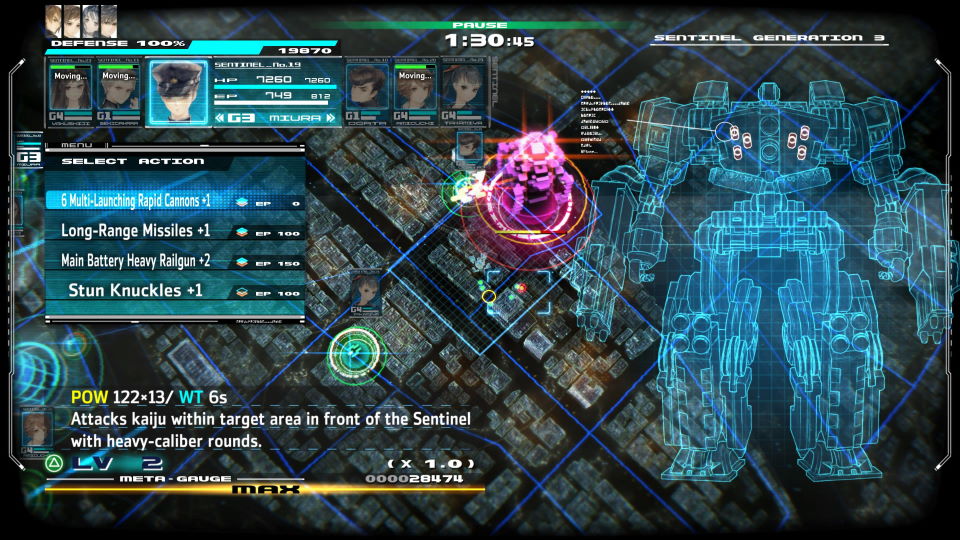
The battle mode is set during the climactic showdown between the kaiju and the robots. You pick six pilots and slowly fight through each phase of the invasion on a real-time strategy map. You can also switch your team’s lineup, upgrade weapons, pick abilities to use, and do general RPG stuff.
This part of the game is decent enough. There are little animations that play when you try to decide what weapons or abilities to use, but as you can see from the image above, the map itself is very simplified. I don’t hate the existing battle mode that we got, and even enjoy the fights, but with the addition of a little more flash, the play experience could have been upgraded for me from “fun” to “ecstatic.”
I want to see mechs wrestling monsters while around them a city gets blasted to smithereens. I want to see my giant robot get knocked through a building and then take cover in a crater formed by a missile bombardment. I want to feel like I’m in a giant robot anime, by damn!
But the story mode delivers – oh, how it delivers. It’s what you should be playing the game for. The story mode is essentially a really simplified adventure game. You play through the recent past of each of the characters and discover the twists that their lives took which led to them piloting a giant robot on the day of reckoning.
The actual game thing that you do is essentially just pressing X. Your character is at a certain location and there are one or two people you can talk to and one or two objects that you can interact with. You progress through the dialogue and try out each conversation topic. Then you move on to the next location and keep doing that until you reach the end of the section you’re playing and decide if you want to continue with your current character or try someone else for a while (or maybe jump back into battle mode).
That’s how the story mode works, but that’s not how it feels. It evokes so much for so little. For me, it’s basically the world’s best anime protagonist simulator. I’m not a connoisseur of visual novels or dating simulators, but I’ve played a few, and in none of them did I feel like I was actually a student in a bustling Japanese high school like this game did. You walk down a hallway at school and there are other students passing you by, and in the background some of your classmates are chatting about the TV show they watched last night. You go with your friends for some ice cream after class and cars whiz by as you wait at the bus stop. Some jerks from the next school over try to start some shit and your friend steps in to back you up.
I call the story mode an anime protagonist simulator because it skips the boring parts of high school and just has the interesting bits in there. And what are those interesting bits? They’re mostly stories copied directly from science fiction movies and TV shows.
Yes, you’ll find that one character is living through the plot of E.T. the Extraterrestrial, while another is living through Terminator 2: Judgment Day, and yet another is experiencing the story of Total Recall. It’s not a simple one-to-one copy, though, and the stories make sense even if you don’t know what they’re referencing, but it’s fun to pick out what the original works were. And the characters’ lives are intertwined, so they get involved in each others’ stories, and a couple of times you even experience the same conversation again but this time you’re controlling the other person.
This game will not click for everyone, but it certainly did for me. Like I mentioned, it’s just so goddamn fun. I enjoy identifying the Robot Jox design elements and figuring out how the characters’ lives intersect with each other. I like feeling like I’m a kid in a Japanese high school anime and I’ve got an alien I need to hide from the Men in Black and also I have to stop the invasion from The War of the Worlds.
A couple of warnings, though. First, just like with many other adventure games, I got stuck a couple of times when I couldn’t figure out how to progress past a certain point. I say you shouldn’t feel guilty about just googling that shit. Keep that advice in mind if you play.
Second, and somewhat more egregiously, time travel is a very important part of the story, and since this is a Japanese story about using military weapons to fight off an invasion, there inevitably shows up two characters from Japan’s most infamous period of militarization. I guess the one guy is okay, he clearly doesn’t care about ideology and is just trying to get by, but the other guy is a true-blue patriot and he keeps shouting about defending the motherland and whatnot. Which would be okay if it was about almost any other country, but not when it’s Imperial Japan. The game isn’t a cryptofascist Trojan horse for Japanese imperialism, but this part definitely left a sour taste in my mind.
Anyway, keeping these things in mind, I would still heartily recommend this game. Like I said in the beginning, it’s great fun and I’m enjoying almost everything about it.
Goodbye, Eri is a one-shot manga about a high school boy who is obsessed with making movies. The first film he makes is a predictably tearjerky documentary about his terminally ill mother. However, at the end he’s unable to join his mother for her final moments and instead runs away, but in his film he adds a special effect to make it look like the hospital is exploding as he flees.
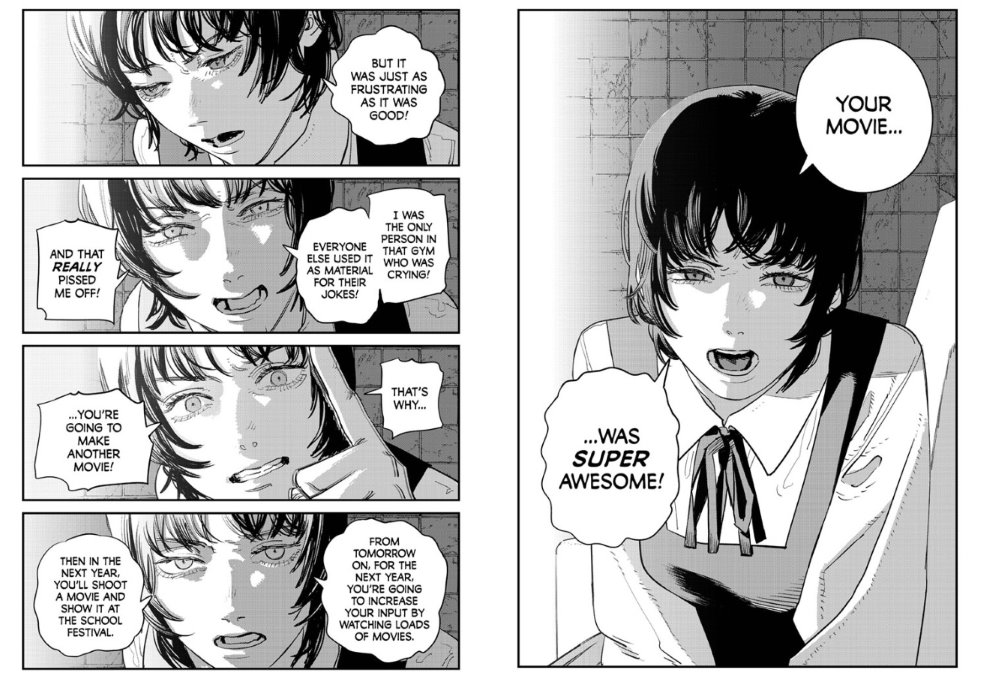
The story begins as he shows his creation at the school festival, where it sinks like a lead balloon. Almost everyone in the school thinks the ending of his film is stupid except for one girl who insists that there was the germ of an interesting idea in there and he just needs to watch more movies to learn what works. Of course, he will be watching the movies with her, since she needs to make sure that his cinematic education proceeds appropriately.
The girl is not manic, but she definitely looks pixie-like and is certainly the kind of film buff a movie nerd would wish for (i.e., almost a full MPDG).
The boy eventually comes up with an idea for his next movie, which will be about a boy who showed a movie about his terminally ill mother which was received poorly by his fellow students, but who then met a girl who constantly watched movies with him and taught him about making a good film. Also the girl is a vampire who’s terminally ill.
Written out like that, the movie sounds earnestly dumb, but it comes across as rather sweet from the perspective that we see, which is entirely from the point of view of the mock documentary that the boy is shooting.
As you can guess, the story plays with ideas of the fourth wall, with unreliable narrators, with constructed images and artifice, and even with death and how the people we’ve lost are still alive and with us anyway. I don’t really want to spoil too much of the story, as it’s best enjoyed without too much foreknowledge, but I do recommend it as being a surprisingly deep exploration of a lot of emotional territory from the guy who wrote a manga about a teenage boy who transforms into a demon made out of chainsaws who uses his powers to hunt other demons (Chainsaw Man, though that manga was also a lot deeper than the bare description would make you think).
The Batman is good. Like damn, those 3 hours flew by. It’s nice that we skip going through Batman’s origin one more time, and it’s certainly novel that the first villain we get to in a Batman reboot is The Riddler, but it works in this movie.
Politically, the movie kind of covers the same territory as in The Dark Knight Rises since it’s about gross inequality and popular reaction to it, but it handles the issue a lot better than the earlier film since it actually has an idea of what it wants to say on the issue. Bane’s live action introduction had a confused and ambivalent reaction to the Occupy Wall Street protests that were ongoing when it was made. However, the world that created The Batman has had over a decade to think over the Occupy movement’s ideas, as well as a global pandemic and a summer of BLM protests. In fact, I would characterize this particular reboot as a post-BLM ACAB version of the Batverse, inasmuch as it can be in a fictional setting where the protagonist’s main problem with cops isn’t that they’re violent but that they’re not directing their brutality toward the right people (i.e., criminals).
The pundit Anand Giridharadas has a quip about billionaires and how they whitewash the terrible reputations they earned while amassing their wealth by giving back some scraps from their fortunes in the form of charity: “Batman is what all these plutocrats do. You cause problems by day, in the way you run your company, and then you put on a suit at night and pretend you are the solution.”
The movie is essentially that quote presented in dramatic form. The problems of Gotham are caused by Bruce Wayne’s family, by their peers, and by the people who enforce their rule – cops, lawyers, mobsters, and so on. Bruce Wayne, ignorant of the larger context, tries to fix things with a child’s understanding of the situation by beating up poor people who’ve turned to crime. It’s not even a band-aid solution, since the worst that a band-aid can do is be ineffective, whereas in the movie, Batman’s example inspires other people to fix their own problems with violence. Of course, socioeconomic inequality isn’t a problem you can punch into submission, and it’s striking how one of the takeaways from this superhero movie is that almost everything heroic that we watch the protagonist do is completely useless and ineffective.
But the movie can only go so far in this critique. The superhero story is rooted in private actors using violence to impose order on a chaotic society. It’s a worldview conducive to being “tough on crime” and unswerving support for the police. Fundamentally, a superhero movie is pro-cop. Which is why, after a supervillain-caused natural disaster, Batman ends up letting go of his original mission of cowing the people of Gotham into submission and instead helps in relief efforts with the US military.
In the end, Catwoman asks Batman to run away with her, but he refuses and instead chooses to stay and help Gotham. She notes that his mission will never end and she ends up walking away from the disaster of trying to save a city that’s actively trying to commit suicide. Batman’s decision is presented as a noble sacrifice, of placing duty over love, but ironically, Catwoman’s proposal that she and Batman spend their lives robbing hedge fund plutocrats probably would have done more to address Gotham’s fundamental problems than Batman’s idea of punching street thugs and the occasional crooked cop.
Anyway, it’s nice when a superhero movie gives you something to think about besides the fight scenes.
I’m reading Civilizations by Laurent Binet. It’s an alternate history novel about the conquest of Western Europe by the Incas.
It starts with a different end to the Viking expeditions to Vinland and continues centuries later with Christopher Columbus getting his just desserts from the Taino. Decades after that, the bulk of the book covers the Sapa Inca Atahualpa’s conquest of Western Europe, and then there’s a substantial epilogue covering the young mercenary Miguel Cervantes’ adventures across the Mediterranean.
The book gives a lot of lucky coincidences to its protagonists, while the indigenous Americans adopt and invent new technologies too quickly, but I’m not complaining since otherwise the story wouldn’t exist. The realistic outcome would have been the one that actually happened in our world, and who needs to run over that again? We can just handwave all that science stuff about Eurasia’s larger disease pool and virgin soil epidemics and whatever.
Anyway, if you’re familiar with Spain’s conquest of the New World then a lot of the Inca section is basically that with the parties reversed. In our world Atahualpa’s father the emperor died from smallpox and a civil war broke out, with Atahualpa defeating his brother to become emperor.
However, here Atahualpa loses and is chased out of the empire with his last 200 followers. They desperately repair Columbus’ wrecked ships and escape east to unknown lands with a Cuban princess who learned Spanish from a certain enslaved Genoese captain.
They end up in Portugal immediately after the Great Lisbon Earthquake of 1531. The chaos gives them a chance to survive and they end up meeting the queen of Spain. However, they’re forced to attack and capture the queen and kill 3000 of Toledo’s Christians after learning that the Inquisition is planning to kill them. There’s a short detour to the centre of learning, Salamanca, for the group to learn about this New World, but the Toledo massacre marks the beginning of a series of escalations that ends with Atahualpa capturing the king of Spain.
The small band had only been doing what they needed to survive each succeeding crisis, but after making contact with Atahualpa’s brother and making peace, they gain the resources to aim higher. Atahualpa uses the gold, silver, and gunpowder supplied by his brother, in exchange for technology and various cultural products (wine, trompe l’oeil paintings, honey, and so on) to become first king of Spain, then Belgium and the Netherlands, and then eventually he unites Germany to become Holy Roman Emperor. Along the way he triumphs over the pirate Barbarossa, takes half the North African coast, and is dubbed conquistador.
Atahualpa’s success is due to the radical reforms he enacts, somewhat by accident and somewhat by design. After first taking the Spanish crown, he guarantees freedom of religion to reward his first European followers, the oppressed Moors and Jews of Spain, but also to allow space for the Incan worship of the sun so central to their rituals and politics. Ending the Inquisition is a popular move and converts quickly flock to a religion backed by a victorious conqueror.
Atahualpa’s second radical reform involves Germany, where by now he has gained a reputation as a champion of the poor, thanks to implementing in Spain certain quasi-socialist Incan political structures (taxes paid in labour, housing provided free by the state, abolition of serfdom, and various radical changes that accord with historical records from our world). Germany has seen repeated peasant revolts over the years and the downtrodden see in Atahualpa their salvation. In turn, Atahualpa is glad enough to invade various German states at the invitation of the residents in his lust for Charlemagne’s throne. A complicated public dialogue with Martin Luther ensues so that Atahualpa can secure the votes of the Protestant electors, but it breaks down and the peasants rise up in anger that their greatest chance has been lost. The electors beg Atahualpa for help and he imposes order and becomes Emperor of the Romans.
Thus, in this alternate world Atahualpa has forestalled Europe’s Wars of Religion, the Thirty Years War which devastated Germany, enacted the Peace of Westphalia a century early, and sidestepped the enclosure of the commons that was to come in later years.
Anyway, this book is pretty fun if you’re familiar with the history it changes. It’s just deliciously clever at developing a world that parallels but doesn’t mirror our own. I probably missed a bunch of stuff in the Cervantes section since I’ve never read Montaigne, who appears as a character, but oh well.
The book is translated from French but I didn’t really notice anything awkward because of this. The vast majority of translated works I read are Japanese, Korean, and Chinese comics, but now that I think about it, the few translated novels I read tend to be French.
So yeah, I recommend this book for aficionados of history.